
Spain's "Sea of Plastic": A Circular Economy Case Study Hiding in Plain Sight
Aerial Photos Document the Expansive Greenhouses Covering Spain's Almería Peninsula 
Source: University of Copenhagen
I'll admit it: when I first came across satellite images of Almería, in southeastern Spain, I genuinely thought I was looking at a snowfield. Thousands of white rooftops, stretching for miles, covering an area roughly half the size of New York City. It's not snow. It's plastic. Over 30,000 hectares of greenhouses, so dense the region has picked up a nickname that sounds almost dystopian: the Sea of Plastic.
But here's the thing that pulled me in as I started digging into the research behind it: this isn't just a farming story. It's one of the more interesting circular economy case studies I've come across recently, a region that turned water scarcity, poverty, and a barren desert into one of Europe's most resource-efficient food systems, while still wrestling openly with the waste and labour problems that success created. That mix of genuine achievement and unresolved cost is exactly why I wanted to write about it.
In short: Almería is a desert region in Spain that now supplies a huge share of Europe's vegetables through a network of low-tech, family-run greenhouses, and it's a real-world test case for circular resource use at scale, not a spotless success story.
From Poorest Province to "El Milagro de Almería"
It's easy to forget that Almería was once one of the poorest, driest, and least agriculturally promising provinces in Spain. It was so barren that filmmakers used it as a stand-in for the American Old West in classic spaghetti westerns. Not exactly what comes to mind when you picture a food powerhouse.
The shift started small and low-tech: farmers layering sand and mulch over poor soil to trap moisture, then adding simple plastic covers to protect crops from wind and heat. Researchers at the University of Almería later traced how this evolved through the 1960s–80s into a full greenhouse economy, helped along by Spain's entry into the EU, which opened tariff-free access to European markets.¹ What followed is now referred to locally as El Milagro de Almería, the Miracle of Almería, and it's a genuinely useful reminder that transformative sustainability solutions don't always require cutting-edge technology. Sometimes they start with sand, plastic sheeting, and a lot of trial and error.
In short: A desert region became one of Europe's biggest vegetable producers not through one breakthrough technology, but through decades of incremental, low-cost innovation.
The Circular Design Underneath the Plastic
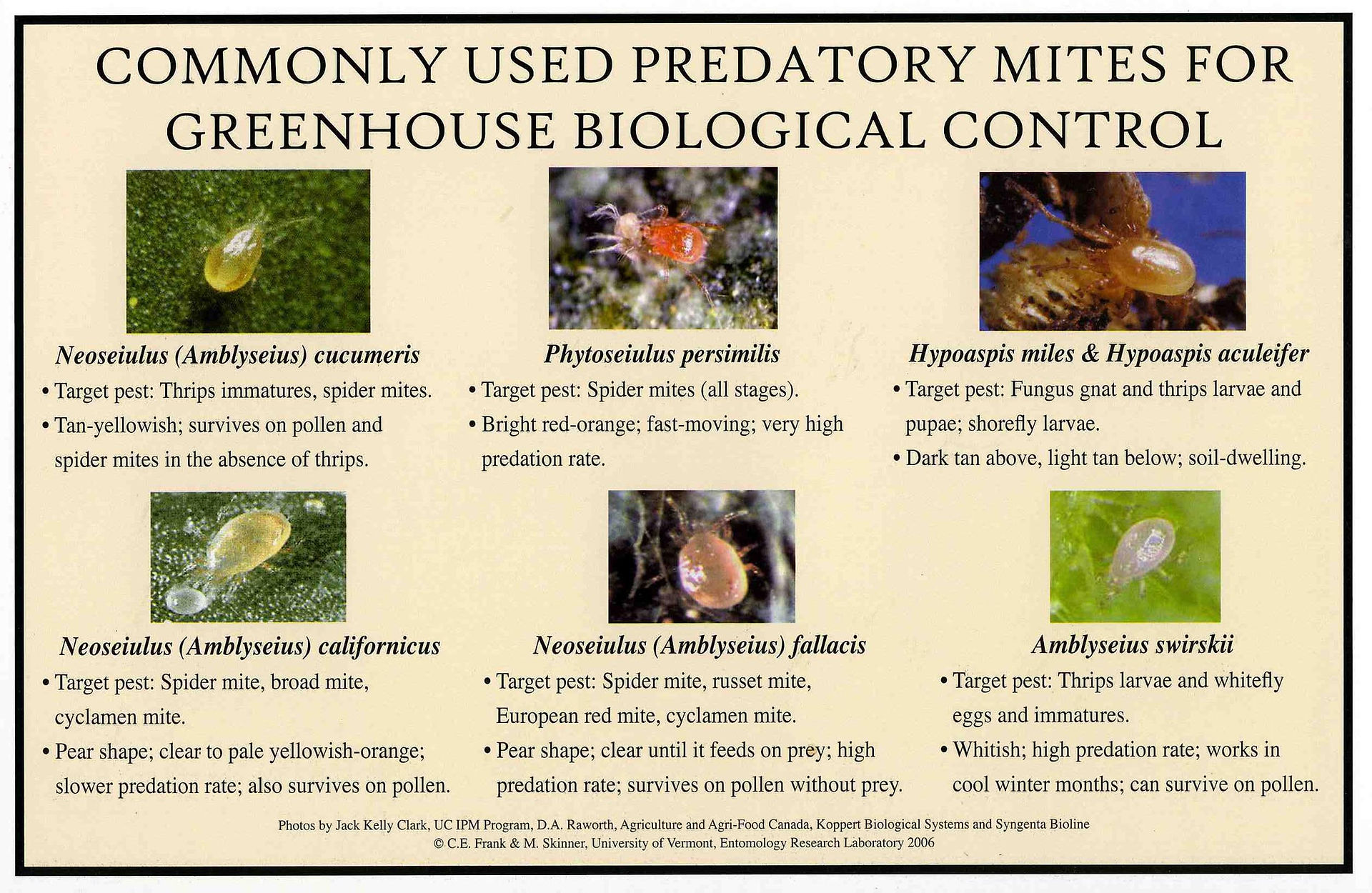
Source: University of Vermont IPM Greenhouse Pests, Biological Controls & Plant Mediated IPM Systems 
source: Wikifarmers - Biological control of greenhouse pests using natural enemies 
Predator Mite (Phytoseiulus persimilis)
What makes this system genuinely relevant to circular economy thinking isn't the plastic itself — it's how tightly the whole production loop is designed around minimising inputs and reusing resources:
Passive solar design. Unlike the heated glass greenhouses common in the Netherlands, Almería's structures need no artificial heating. With over 300 sunny days a year, the sun does that work for free — a form of resource efficiency baked into the region's geography rather than its engineering.
Soilless, closed-loop substrates. Around 90% of production now happens in sand-clay-manure substrates fed by drip irrigation rather than open soil, giving growers precise control over water and nutrient inputs instead of losing them to runoff and evaporation.
Low-cost, replicable infrastructure. A functioning greenhouse — frame, film, irrigation lines — can be built for roughly €60–70 per square metre, which is part of why thousands of small, independent farms could participate instead of only large agribusiness.
Passive summer cooling. During heat spikes, growers coat greenhouse roofs in chalk to reflect sunlight, then wash it off when more light is needed — a cheap, reversible, zero-energy climate control method.
In short: This is circular economy thinking applied to farming infrastructure — designing the system to run mostly on sun, reused water, and reversible low-tech interventions rather than constant new inputs.
Water: The Number That Actually Matters
If there's one figure worth remembering from all of this, it's water. Almería receives only about 200mm of rainfall a year, yet its greenhouse system uses roughly six to seven times less water per kilogram of produce than open-field farming, and industry research puts productivity gains at up to twelve times more food per unit of water compared to some conventional methods.² A single hectare under plastic here can also be dramatically more productive than the European farmland average.
That's not a marginal efficiency gain, it's the kind of number that should matter to anyone working on food systems in a warming, drought-prone Europe. It also happens to be the clearest circular economy insight in the whole story: close the loop on water use, and yield doesn't have to suffer. It can actually improve.
In short: Almería's greenhouses produce far more food per litre of water than traditional farming, arguably the single most transferable lesson here for other regions facing water stress.
Replacing Chemical Inputs With Biological Ones
Landfill for municipal waste recycling Cartagena, Murcia, Spain

In 2007, Almería had its own reckoning: pesticide residue was found on exported peppers, triggering a genuine reputational crisis. Instead of quietly patching the problem, the region's growers pivoted hard toward biological pest control — what researchers call Integrated Pest Management (IPM).³
Rather than spraying chemicals, farms now introduce "banker plants" that host beneficial insects, alongside specific predator species: parasitic wasps that target whiteflies, predatory mites that go after thrips, and predator bugs that handle multiple pests at once. It's a genuinely elegant substitution, swapping a linear, external chemical input for a self-sustaining biological system already present in the local ecosystem.
In short: A food-safety scandal pushed the region to replace chemical pesticides with insect-based pest control, a textbook example of substituting a linear input with a closed, regenerative one.
Cooperation as Infrastructure
One detail that surprised me: Almería isn't dominated by a handful of agribusiness giants. It's made up of thousands of small, often multi-generational family farms. Individually, none of them would have much leverage negotiating with major European supermarket chains.
So instead of competing, they cooperate, pooling harvests and selling collectively through cooperatives that negotiate prices and stabilise incomes across the year. Some cooperatives, like La Palma, now represent hundreds of individual growers and have set public zero-waste targets of their own.⁴ It's a reminder that circular economy solutions aren't only about materials and water, they're also about the social and economic infrastructure that lets small producers stay viable instead of getting swallowed by consolidation.
In short: Rather than consolidating into large corporate farms, Almería's growers built cooperative structures that let thousands of small producers compete collectively, a social innovation as important as any technical one.
The Part the "Miracle" Doesn't Advertise
No fair account of this system can skip its real costs, and there are two big ones.
Plastic waste: Greenhouse film typically needs replacing every two to four years, and the region generates somewhere between 30,000 and 48,000 tonnes of plastic waste annually, depending on the year and how it's measured.⁵ Recycling programmes now capture a large share of it, regional estimates range from roughly 85% up to higher figures depending on the source, but the remainder still ends up in unregulated landfills or the surrounding environment. Researchers studying the region's marine microplastic levels have found concentrations well above nearby averages, and the sperm whale found in 2013 with 17kg of plastic debris in its stomach, much of it agricultural film, remains a stark symbol of the problem.⁶
Labour conditions: More than 70,000–80,000 people work in these greenhouses, many of them migrants from Morocco, Mali, and other parts of North and sub-Saharan Africa. Independent reporting and academic reviews have documented workers living in informal settlements, known locally as chabolas, often without reliable access to clean water or sanitation.⁷ It's a hard truth acknowledged even in regional assessments: this export economy has depended heavily on cheap, precarious labour.
These aren't footnotes. If we're going to hold this up as a circular economy model worth learning from, we also have to be honest that "resource-efficient" and "socially sustainable" aren't automatically the same thing.
In short: Almería's efficiency comes with real environmental and social costs, plastic pollution and difficult labour conditions that any serious circular economy analysis has to include, not gloss over.
How Could This Actually Be Implemented Elsewhere?

This is the part I think matters most for readers of a site like this one. Almería's exact conditions, 300+ sunny days a year, mild winters, cheap land, won't transplant to Northern Europe. But several of its underlying design principles absolutely could, and some already are being tested closer to home:
Build cooperative structures in early, not later. Small-scale producers, whether vegetable growers, or closer to my own work, small Baltic seaweed and microalgae cultivators, gain real bargaining power and stability by pooling resources through cooperatives, rather than trying to scale individually against larger competitors.
Design closed-loop water and nutrient systems from day one. The substrate-and-drip-irrigation approach used in Almería maps directly onto hydroponic and vertical farming systems already being piloted across Germany and the Nordics, where land and light, not water, tend to be the limiting factor.
Substitute biological inputs for chemical ones wherever possible. IPM-style pest management isn't climate-dependent, it's a transferable circular principle that greenhouse operations anywhere, including German horticulture, can adopt.
Treat plastic and material waste as a design problem, not an afterthought. Almería's biggest unresolved issue is arguably its clearest lesson: any new greenhouse, aquaculture, or algae farming project should build in recycling and end-of-life material planning from the start, rather than trying to retrofit it decades in.
Align policy incentives with resource efficiency, not just yield. Much of Almería's original push came from a specific historical policy moment. The broader lesson for today's policymakers is that subsidies and regulation shape what actually gets built, so tying support to water and material efficiency, not just output volume, tends to produce better long-term outcomes.
In short: Almería's specific climate can't be copied, but its core principles — cooperative structures, closed-loop resource systems, biological over chemical inputs, and designing out waste early — are genuinely exportable to circular economy projects in Northern Europe.
Key Takeaways
Resource scarcity can be a design constraint, not just a limitation. Almería turned a lack of water and fertile soil into the very thing that forced its system to become efficient.
Low-tech, well-integrated solutions can outperform high-tech ones. Sand, plastic film, chalk, and drip irrigation, combined thoughtfully, beat energy-intensive heated greenhouses on cost and water use.
Water efficiency is the standout, most transferable lesson. Producing far more food per litre of water than conventional farming is directly relevant to any drought-prone region — including much of Europe going forward.
Cooperation is circular economy infrastructure too. Distributing bargaining power through cooperatives let thousands of small farms remain viable instead of consolidating into a few large operations.
Efficiency and sustainability are not the same thing. Almería's plastic waste and labour conditions are a reminder that any circular model has to account for material end-of-life and human welfare, not just resource throughput.
References
NASA Earth Observatory (2022). Almería's Sea of Greenhouses. science.nasa.gov
Campra, P. et al. Journal of Geophysical Research (2008), on greenhouse albedo and regional cooling effects in Almería; further discussed in HortiDaily (2019), Spain: Cooling greenhouse surface trend in Almería.
International Journal of Environmental Research and Public Health (2019). Six Collective Challenges for Sustainability of Almería Greenhouse Horticulture.
John Deere, The Furrow (2024). A Miracle in Plastic — on cooperative structures including La Palma.
Resources, Conservation and Recycling (2021). Inorganic Waste Management in Greenhouse Agriculture in Almería (SE Spain): Towards a Circular System in Intensive Horticultural Production; additional waste volume data via PMC (2021), Plastic waste in intensive agriculture in Almería.
Marine Pollution Bulletin (2013). As main meal for sperm whales: Plastic debris; FoodUnfolded (2021), The Environmental Impacts of Greenhouse Agriculture in Almería, Spain.
REVOLVE Media (2024). Navigating Spain's Plastic Sea; PubMed (2020), Improving the climate safety of workers in Almería-type greenhouses in Spain.


Comments