
Understanding Sustainability: Key Concepts and Practices
Updated: Aug 12
Sustainability is one of those words that gets used so often, in so many contexts, that its actual meaning can become blurry. A product label, a corporate report, a government policy and a university course might all claim to be about sustainability, yet mean quite different things by it. For a site built around evidence based, practical solutions, it is worth slowing down and looking closely at where the concept came from, how researchers and policymakers currently define it, and which frameworks are used to put it into practice. This piece works through that history and vocabulary in plain language, with references to the scholarship and international agreements that shaped the field, so that the ideas that follow on this site rest on solid ground.
Where the Idea of Sustainability Came From

Sustainability did not appear out of nowhere. It grew out of decades of environmental warning signs that accumulated through the twentieth century. In the 1970s, researchers began documenting how pollution crossed borders, for instance showing that a large share of the acid rain falling on Sweden originated in other countries, which eventually led to international agreements on transboundary air pollution. Around the same time, chemists identified how chlorofluorocarbons were damaging the ozone layer, a finding confirmed a decade later by the discovery of the ozone hole over Antarctica and formalized into policy through the Montreal Protocol of 1987. By the early 1980s, government scientific bodies in the United States were already warning that rising atmospheric carbon dioxide and other greenhouse gases would likely drive global warming.
These separate environmental crises, air pollution, ozone depletion, climate change and biodiversity loss, gradually converged into a single realization: human economic activity was reshaping the planet's basic life support systems, and doing so faster than most institutions could respond. This realization culminated in 1987 with the publication of Our Common Future, commonly known as the Brundtland Report, produced by the World Commission on Environment and Development. The report argued that protecting the environment, reducing global inequality and fighting poverty were not obstacles to economic growth but could actually reinforce it if pursued together (WCED, 1987). This was the moment the term sustainable development entered mainstream policy language, and it set the stage for everything that followed, from the 1992 Earth Summit in Rio de Janeiro to the Sustainable Development Goals adopted more than two decades later.
Modern sustainability thinking emerged from a string of environmental crises in the 1970s and 80s, acid rain, ozone depletion, early climate warnings, that convinced scientists and policymakers the environment, economy and society needed to be managed as connected systems rather than separate problems.
Defining Sustainable Development
The Brundtland Report gave the field its most widely cited definition, describing sustainable development as development that satisfies the needs of people living today without undermining the capacity of future generations to meet their own needs (WCED, 1987). It is a deceptively simple sentence, but it introduces an idea that still drives debate almost forty years later: sustainability is fundamentally about fairness across time, not just about protecting nature for its own sake.
The word itself is worth pausing on. Sustain comes from the Latin sustenere, meaning to uphold or support, while develop carries a sense of strengthening, enlarging or making more complex. Put together, sustainable development asks whether it is possible to keep expanding human wellbeing while also upholding the ecological and social systems that make that wellbeing possible in the first place. Whether those two goals can really be reconciled, or whether they sit in permanent tension, is a question that runs through much of the academic literature on the topic, and it is one this site will return to often.
Sustainable development means meeting present needs without compromising the ability of future generations to meet theirs, a definition that puts intergenerational fairness at the center of the concept rather than treating it as a purely environmental issue.
The Three Pillars and the Triple Bottom Line

One of the most practical frameworks to come out of this thinking is the idea of three interlocking pillars: environmental, economic and social sustainability. This is often referred to as the triple bottom line, a term popularized by John Elkington in the business world, which frames sustainability as the simultaneous pursuit of people, planet and profit rather than profit alone (Elkington, 1997). A company, a city or a policy is judged not just on financial performance but on whether it also protects ecosystems and improves social conditions.
This framework has been extremely influential, particularly in business and corporate reporting, because it translates an abstract idea into three measurable categories that organizations can track and report against. At the same time, critics have pointed out that treating the three pillars as equally weighted and separable can be misleading, since the economy and society ultimately depend on functioning ecological systems rather than existing alongside them as equals. Some researchers instead depict the economy as nested within society, and society as nested within the environment, which changes the framework from three overlapping circles into a set of concentric ones. This distinction matters more than it might first appear, and it leads directly into a longer running debate in the field.
The triple bottom line frames sustainability as the joint pursuit of environmental, economic and social goals, a useful and widely adopted tool, though many scholars argue the environment should be treated as the foundation the other two depend on rather than an equal partner.
Weak Versus Strong Sustainability

Economists and ecologists have long disagreed about how much natural capital, things like forests, fisheries, clean water and a stable climate, can be replaced by human made capital such as technology, infrastructure or financial wealth. This disagreement is usually summarized as the debate between weak and strong sustainability.
Weak sustainability holds that natural and human made capital are substitutable, so what matters is that the total stock of capital, combining both types, does not decline over time. Under this view, depleting a forest is acceptable if the proceeds are reinvested into infrastructure or education that generates equivalent value. Strong sustainability rejects this substitutability for a wide range of ecological functions. It holds that certain forms of natural capital, a stable climate, a functioning ozone layer, viable ecosystems, are simply not replaceable by human ingenuity or built infrastructure, and that economic and social activity should be understood as operating within environmental limits rather than trading against them (Daly, 1990; Neumayer, 2003).
This is not a purely academic dispute. It has real consequences for policy. A weak sustainability framing tends to support market based solutions such as carbon trading or biodiversity offsets, where damage in one place can be compensated elsewhere. A strong sustainability framing is far more cautious about such trade offs and instead argues for hard limits on resource use and environmental degradation, regardless of the economic value created elsewhere. Understanding which assumption underlies a given policy or business claim is often the key to evaluating whether it is genuinely evidence based or simply reframing business as usual in sustainability language.
Weak sustainability assumes natural and human made capital can substitute for one another as long as total capital is preserved, while strong sustainability treats many ecological functions as irreplaceable, a distinction that shapes whether policies favor market trade offs or firm environmental limits.
Planetary Boundaries and the Question of Scale

A more recent and increasingly influential framework asks a different question: are there measurable limits to how much pressure human activity can place on the Earth system before it destabilizes? This is the planetary boundaries framework, first proposed by Rockström and colleagues, which identifies nine Earth system processes, including climate change, biodiversity loss, freshwater use, and nitrogen and phosphorus cycles, each with an estimated safe threshold (Rockström et al., 2009). According to more recent assessments building on this original framework, several of these boundaries have already been crossed, most notably those linked to climate change, biodiversity loss and the disruption of global nutrient cycles by fertilizer use.
A related and much older tool for thinking about scale is the IPAT identity, which expresses environmental impact as the product of population, affluence and technology (Ehrlich and Holdren, 1970). It is a simple equation, but it is useful precisely because it forces a conversation about which lever is actually driving a given environmental problem. Is impact rising because of population growth, rising consumption per person, or the environmental intensity of the technology being used to produce goods and services? Applying this framework to income data also reframes sustainability as a question of inequality and not only of aggregate scale, since higher income households and countries generally claim a disproportionate share of any given environmental budget compared with lower income ones.
The planetary boundaries framework identifies measurable ecological limits the global economy should not exceed, several of which have already been breached, while tools like the IPAT identity help clarify whether population, affluence or technology is the main driver behind a specific environmental pressure.
Sustainability Science as a Field of Study

As these ideas matured, they gave rise to a distinct academic field known as sustainability science. Unlike traditional disciplines that are organized around a single subject matter, sustainability science is organized around a problem, understanding and managing the interactions between human and natural systems in a way that supports long term wellbeing. It is often described as problem driven and use inspired rather than purely curiosity driven, meaning research questions are chosen because they matter to real world decisions, not only because they are theoretically interesting (Kates et al., 2001).
Because sustainability problems rarely respect disciplinary boundaries, the field is inherently inter and transdisciplinary, drawing on ecology, economics, sociology, engineering and political science, and frequently involving collaboration with policymakers, businesses and communities rather than academics working in isolation. A well documented challenge within the field is what researchers have called the sustainability gap, the persistent distance between what science tells us needs to happen and what actually gets implemented in policy and practice (Fischer et al., 2007). Closing that gap, rather than simply describing problems more precisely, is increasingly seen as the central task of the discipline.
Sustainability science is a problem focused, transdisciplinary field aimed at understanding and managing human environment interactions, and much of its current effort is directed at closing the persistent gap between scientific knowledge and real world action.
The Sustainable Development Goals

In 2015, the United Nations adopted the Sustainable Development Goals, a set of seventeen goals covering issues from poverty and hunger to clean water, climate action, gender equality and responsible consumption, intended to guide global development policy through 2030 (United Nations, 2015). The SDGs built directly on an earlier framework, the Millennium Development Goals adopted in 2000, but broadened the scope considerably, applying to all countries rather than only developing ones, and explicitly integrating environmental, economic and social targets within a single framework, echoing the triple bottom line logic described earlier.
What makes the SDGs particularly relevant to evidence based sustainability work is that each goal is paired with specific, measurable targets and indicators, allowing progress to be tracked empirically rather than asserted rhetorically. This has made the goals a common reference point across sectors, used by governments setting national policy, companies reporting on their environmental and social performance, and researchers evaluating whether particular interventions actually move the needle on outcomes like biodiversity conservation or emissions reduction. At the same time, repeated independent assessments have found that progress on most goals remains well behind the pace needed to meet the 2030 targets, which returns us to the sustainability gap discussed above (Fischer et al., 2007).
The seventeen Sustainable Development Goals, adopted by the United Nations in 2015, translate the broad idea of sustainable development into measurable targets spanning social, economic and environmental domains, though current evidence shows progress lagging behind what is needed by 2030.
Systems Thinking and Resilience
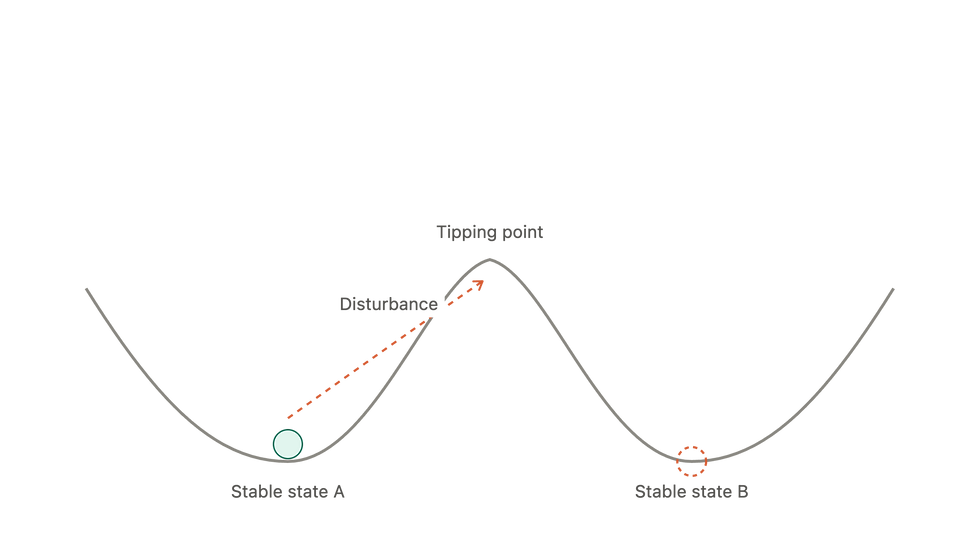
A final concept worth understanding is resilience, which shifts the focus from static targets toward how systems behave over time, especially under stress. Resilience thinking builds on systems thinking, the recognition that ecological, social and economic systems are more than the sum of their parts, with components that influence one another in ways that are often not obvious from looking at any single piece in isolation.
The ecologist C. S. Holling drew an important distinction between two types of resilience. Engineering resilience refers to how quickly a system returns to its original state after a disturbance, while ecological resilience refers to a system's capacity to keep functioning at all, even if it settles into a different configuration afterward (Holling, 1973). Sustainability science is generally more interested in the second kind, since a system that appears to bounce back quickly may actually be losing the deeper capacity to absorb future shocks. This has practical implications well beyond ecology. Studies of traditional home gardens in Tanzania, for example, have shown that the redundancy built into diverse planting systems, growing many different crops rather than optimizing for one, sacrifices some short term yield but provides far greater resilience against pests, drought and market shocks. The same logic increasingly informs thinking about food systems, energy grids and financial systems, where efficiency and resilience often pull in opposite directions.
Resilience describes a system's capacity to keep functioning through disturbance rather than simply how fast it recovers, and research across ecological and social systems consistently shows that redundancy and diversity, even when they reduce short term efficiency, tend to strengthen long term resilience.
Bringing the Concepts Together
None of these frameworks, the triple bottom line, weak and strong sustainability, planetary boundaries, the SDGs, resilience thinking, stands alone. They overlap and sometimes conflict, and part of thinking rigorously about sustainability is learning to recognize which framework is doing the work behind a particular claim or policy. A company advertising that it has become carbon neutral through offsets is implicitly relying on a weak sustainability logic. A scientist warning that a particular fishery is approaching collapse is drawing on strong sustainability and planetary boundary thinking. A community redesigning its food system around crop diversity rather than maximum yield is applying resilience thinking in practice.
For a site focused on evidence based sustainable solutions, the value of laying out these concepts clearly is that it gives readers the vocabulary to evaluate claims rather than simply accept them. Sustainability is not a single fixed idea but a family of related concepts, each with its own history, its own assumptions and its own body of supporting research. Understanding that family, and where each concept fits within it, is the first real step toward telling the difference between practices that are genuinely evidence based and those that only sound that way.
References
Daly, H. E. (1990). Toward some operational principles of sustainable development. Ecological Economics, 2(1), 1 to 6.
Ehrlich, P. R., and Holdren, J. P. (1970). Impact of population growth. Science, 171(3977), 1212 to 1217.
Elkington, J. (1997). Cannibals with Forks: The Triple Bottom Line of 21st Century Business. Capstone Publishing.
Fischer, J., Manning, A. D., Steffen, W., Rose, D. B., Daniell, K., Felton, A., Garnett, S., Gilna, B., Heinsohn, R., Lindenmayer, D. B., MacDonald, B., Mills, F., Newell, B., Reid, J., Robin, L., Sherren, K., and Wade, A. (2007). Mind the sustainability gap. Trends in Ecology and Evolution, 22(12), 621 to 624.
Holling, C. S. (1973). Resilience and stability of ecological systems. Annual Review of Ecology and Systematics, 4, 1 to 23.
Kates, R. W., Clark, W. C., Corell, R., Hall, J. M., Jaeger, C. C., Lowe, I., McCarthy, J. J., Schellnhuber, H. J., and colleagues. (2001). Sustainability science. Science, 292(5517), 641 to 642.
Neumayer, E. (2003). Weak Versus Strong Sustainability: Exploring the Limits of Two Opposing Paradigms. Edward Elgar Publishing.
Rockström, J., Steffen, W., Noone, K., Persson, A., Chapin, F. S., Lambin, E. F., and colleagues. (2009). A safe operating space for humanity. Nature, 461, 472 to 475.
United Nations. (2015). Transforming Our World: The 2030 Agenda for Sustainable Development. UN General Assembly Resolution A/RES/70/1.
World Commission on Environment and Development (WCED). (1987). Our Common Future. Oxford University Press.


Comments