
Why Sustainability Sciences and Materials Matter More Than Ever
The world is changing faster than most industries can keep up with. Renewable energy is no longer a niche investment, cleaner production systems are becoming a baseline expectation, and the way we source and use materials is being rewritten from the ground up. Sustainability has stopped being a marketing talking point. It is turning into the operating logic for how economies, companies, and everyday products are built.
At the center of that shift sits something most people rarely think about: materials and chemistry. Every solar panel, electric vehicle battery, biodegradable package, and low carbon building depends on decisions made years earlier in a materials lab. This is where the real work of sustainability happens, long before a product ever reaches a shelf or a headline.
The Sustainable Materials Market Is Growing Faster Than Almost Anyone Expected
Sustainability was once treated as a compliance box to check. That is no longer true. Companies across nearly every sector are now:
switching to renewable energy in their manufacturing and supply chains
redesigning products so they last longer and break down less often
cutting waste out of production lines instead of managing it after the fact
rebuilding supply chains around recycled, bio based, and lower carbon inputs
The scale of this shift shows up clearly in the numbers. Market analysts at Precedence Research estimate the global sustainable materials market was worth about 421 billion dollars in 2026 and is on track to reach roughly 1.18 trillion dollars by 2035, growing at a compound annual rate of just over 12 percent.1 Other research firms land on slightly different figures, with estimates for 2035 ranging as high as 1.84 trillion dollars, but every major forecast agrees on the same basic story: this is one of the fastest growing material categories in the global economy.2
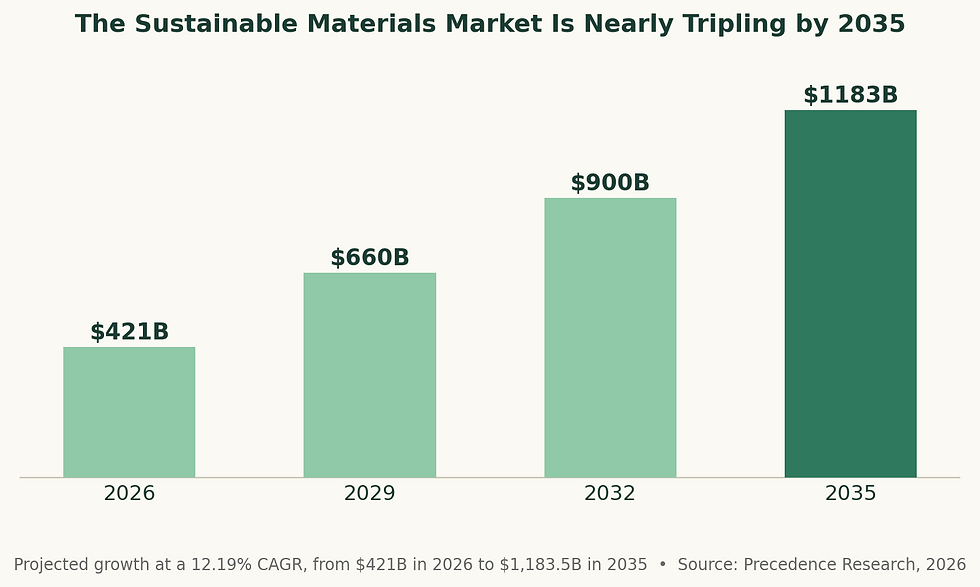
Recycled metals currently lead the market by volume, while biodegradable plastics are expected to be the fastest growing category over the next decade, driven by packaging regulation and consumer demand for compostable alternatives.1Construction is following a similar path. The global market for sustainable construction materials, things like low carbon concrete, engineered timber, and recycled aggregate, is projected to grow from around 359 billion dollars in 2026 to nearly 567 billion dollars by 2030.3
What makes this trend hard to ignore is how visible it has become. Search almost any major company today and you will find a dedicated sustainability page, a carbon reduction target, or a responsible sourcing policy. That is not a coincidence. It reflects a genuine restructuring of how businesses plan for the next decade, not a passing trend they can quietly drop.
Why Materials and Chemistry Sit at the Center of the Problem
Look closely at anything around you right now, your phone, your clothing, the building you are sitting in, and you will find the same underlying question: what is this made of, how was it produced, and what happens to it when it is thrown away.
That question is exactly what materials science and chemistry exist to answer. Researchers in this field work on problems like:
designing biodegradable materials that break down safely instead of persisting for centuries
improving recycling technology so more materials can actually be recovered and reused
replacing harmful or toxic chemicals in manufacturing with safer alternatives
engineering lighter, stronger materials that reduce the energy needed to transport and use them
The scale of the plastic problem alone explains why this work matters so much. According to the OECD's Global Plastics Outlook, the world produced 460 million tonnes of plastic in 2019, more than double what it produced in 2000, and generated 353 million tonnes of plastic waste that same year.4 After accounting for losses during processing, only about 9 percent of that waste was actually recycled. Roughly 19 percent was incinerated, about half went to landfill, and the remaining 22 percent was dumped, burned in the open, or leaked directly into the environment.4

Recycled plastic still makes up only about 6 percent of total plastic production worldwide, even though output of recycled content has more than quadrupled since 2000.4 That gap is not a failure of willpower. It is a materials science and infrastructure problem, and closing it is exactly the kind of work sustainable materials research is built to do. Better polymer chemistry, easier to sort packaging, and genuinely compostable alternatives can move that 9 percent number in a way that public pressure alone never will.
A System That Feeds Itself
What makes sustainability such an interesting field to work in is how tightly everything connects. Better materials lead to better products. Better products reduce waste and emissions across their entire lifecycle. Less waste means fewer resources have to be extracted in the first place. And every new solution that gets developed opens the door to new sustainability careers, which in turn produce more innovation.
It becomes a genuine feedback loop: innovation creates impact, impact creates opportunity, and opportunity funds the next round of innovation.
The scale of what is still lost in that loop today is enormous. The Circularity Gap Report 2026, produced by Circle Economy in partnership with Deloitte, found that the global economy is only 6.9 percent circular, meaning 93.1 percent of all materials used worldwide still come from newly extracted, virgin sources rather than being reused or recycled.5 The same report estimates that this linear, take make waste approach wastes about 25.4 trillion euros in economic value every single year, equivalent to nearly a third of global GDP.5

That number is worth sitting with. It means that for every three euros of value the global economy creates, roughly one euro is lost to resource inefficiency, premature disposal, and assets that never get used to their full potential.5 Closing even a fraction of that gap through better material design, longer product lifespans, and smarter recovery systems represents one of the largest available opportunities in the modern economy, not just an environmental fix.
From Niche Practice to Standard Business Behavior
Ten years ago, publishing a sustainability report was unusual. Today, it is close to universal among large companies. The Governance & Accountability Institute has tracked this shift among S&P 500 companies since 2011, when only about 20 percent published any kind of sustainability or corporate responsibility report. By 2024, that figure had climbed to 99 percent.6
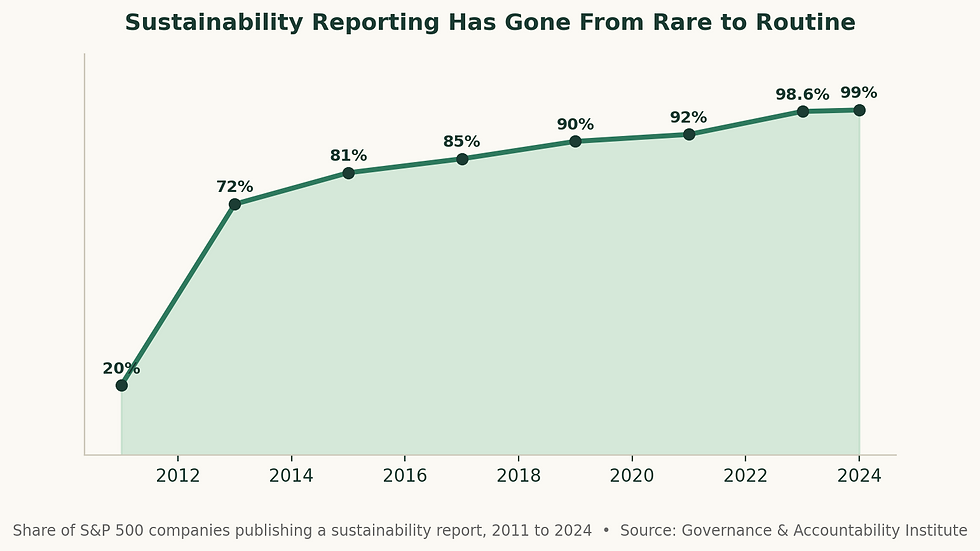
This is not just a story about disclosure paperwork. It reflects a deeper change in how investors, regulators, and customers now expect companies to operate. Reporting frameworks like the Sustainability Accounting Standards Board and the Task Force on Climate related Financial Disclosures have gone from obscure acronyms to standard reference points, used by 82 percent and 65 percent of Russell 1000 reporters respectively as of 2024.7 In Europe, the shift has gone even further. Every company listed on the UK's FTSE 100, Germany's DAX, France's CAC, and several other major indices published a sustainability report in 2025, a full 100 percent reporting rate.8
Whether or not every one of these reports leads to real change is a fair question, and reporting volume has occasionally dipped for administrative reasons.8 But the underlying signal is consistent. Sustainability performance has moved from the margins of corporate strategy into its core, the same category as financial results and operational risk.
Where This Is All Going: Careers Built on Real Demand
We are still early in this transition, and that is exactly what makes it a good time to get involved. Entire industries are only beginning to adapt, which means there is still enormous room for new ideas, new materials, and people willing to learn the science behind them.
The labor market data backs this up clearly. LinkedIn's 2025 Green Skills Report, based on more than a billion member profiles across 84 countries, found that global demand for green skills grew by nearly 8 percent per year between 2021 and 2025, almost twice the 4.3 percent annual growth in the number of workers who actually hold those skills.9 The World Economic Forum's Future of Jobs Report 2025 goes further, projecting that environmental engineer and renewable energy engineer roles will rank among the fifteen fastest growing careers worldwide through 2030, with net growth of roughly 40 percent and 38 percent respectively.10

The International Labour Organization projects that green jobs worldwide will grow to 24 million by 2030.11 Perhaps the most telling detail in the LinkedIn data is that green skills are no longer confined to job titles with "sustainability" in them. In 2025, for the first time, the majority of workers hired for roles requiring green skills, 53 percent, were hired into jobs without any sustainability specific title at all, spanning operations, manufacturing, logistics, and finance.9 Understanding materials, systems thinking, and circular economy principles is becoming a genuinely transferable skill set, not a specialist sideline.
Final Thought
Sustainability is not one single field you either study or ignore. It is a combination of science, systems thinking, and practical application, and materials sit right at the center of nearly all of it. The data makes the direction fairly hard to argue with: markets are growing, reporting has become standard practice, the economic cost of staying linear is measured in trillions, and demand for people who understand this work is outpacing the supply of qualified talent.
The more people understand circular economy principles, from how a polymer is designed to how a supply chain is structured, the better equipped we are to build a future that works for people and the planet at the same time. Not by talking about the problem from the sidelines, but by actually doing the work of solving it.
References
Precedence Research. "Sustainable Materials Market Size Worth USD 1,183.54 Billion By 2035." GlobeNewswire, January 2026. https://www.globenewswire.com/news-release/2026/01/22/3223781/0/en/Sustainable-Materials-Market-Size-Worth-USD-1-183-54-Billion-By-2035.html ↩ ↩2
Expert Market Research. "Sustainable Materials Market Size & Share Analysis 2035." June 2026. https://www.expertmarketresearch.com/reports/sustainable-materials-market ↩
The Business Research Company. "Sustainable Construction Materials Global Market Report." July 2026. https://www.thebusinessresearchcompany.com/report/sustainable-construction-materials-global-market-report ↩
OECD. "Global Plastics Outlook: Economic Drivers, Environmental Impacts and Policy Options." February 2022. https://www.oecd.org/en/publications/2022/02/global-plastics-outlook_a653d1c9.html ↩ ↩2 ↩3
Circle Economy and Deloitte Netherlands. "Circularity Gap Report 2026." April 2026. https://dashboard.circularity-gap.world/report/2026/cgr-2026-overview ↩ ↩2 ↩3
Governance & Accountability Institute, cited in CSO Futures. "Nearly All Companies in the S&P 500 Now Report on Sustainability." October 2025. https://www.csofutures.com/news/nearly-all-companies-in-the-s-p-500-now-report-on-sustainability/ ↩
Governance & Accountability Institute. "Sustainability Reporting Trends." 2025. https://www.ga-institute.com/research/research/sustainability-reporting-trends/ ↩
Datamaran. "Sustainability Reporting in the US in 2025: Changes in Timing, Titles, and Tone." October 2025. https://blog.datamaran.com/sustainability-reporting-in-the-us-in-2025 ↩ ↩2
LinkedIn. "2025 Green Skills Report," cited in ESG Today, December 2025. https://www.esgtoday.com/hiring-rate-for-workers-with-green-skills-dramatically-outpaces-broader-market-as-demand-outpaces-supply-linkedin-survey/↩ ↩2
World Economic Forum. "Future of Jobs Report 2025," cited in CSO Futures, January 2025. https://www.csofutures.com/news/wef-and-linkedin-forecast-bright-future-for-sustainability-jobs/ ↩
International Labour Organization, cited in MIT Legatum Center. "Riding the Green Wave to a Sustainable Career." https://gof.mit.edu/riding-the-green-wave-to-a-sustainable-career ↩


Comments